Verification & Data Integrity
Every contact is checked as it happens. When a donor, a client, or an elections office asks how you got your numbers, you have the record.
 Gold Winner Innovation in Campaign Technology
If you are a canvasser, please reach out to your program admin for support. This form is not monitored for canvasser inquiries.
The field has a trust problem
Fake knocks, spoofed GPS, curbed doors, invented signatures. It happens on real campaigns, it makes the news, and it poisons everything downstream: your targeting, your budget, your donors’ patience.
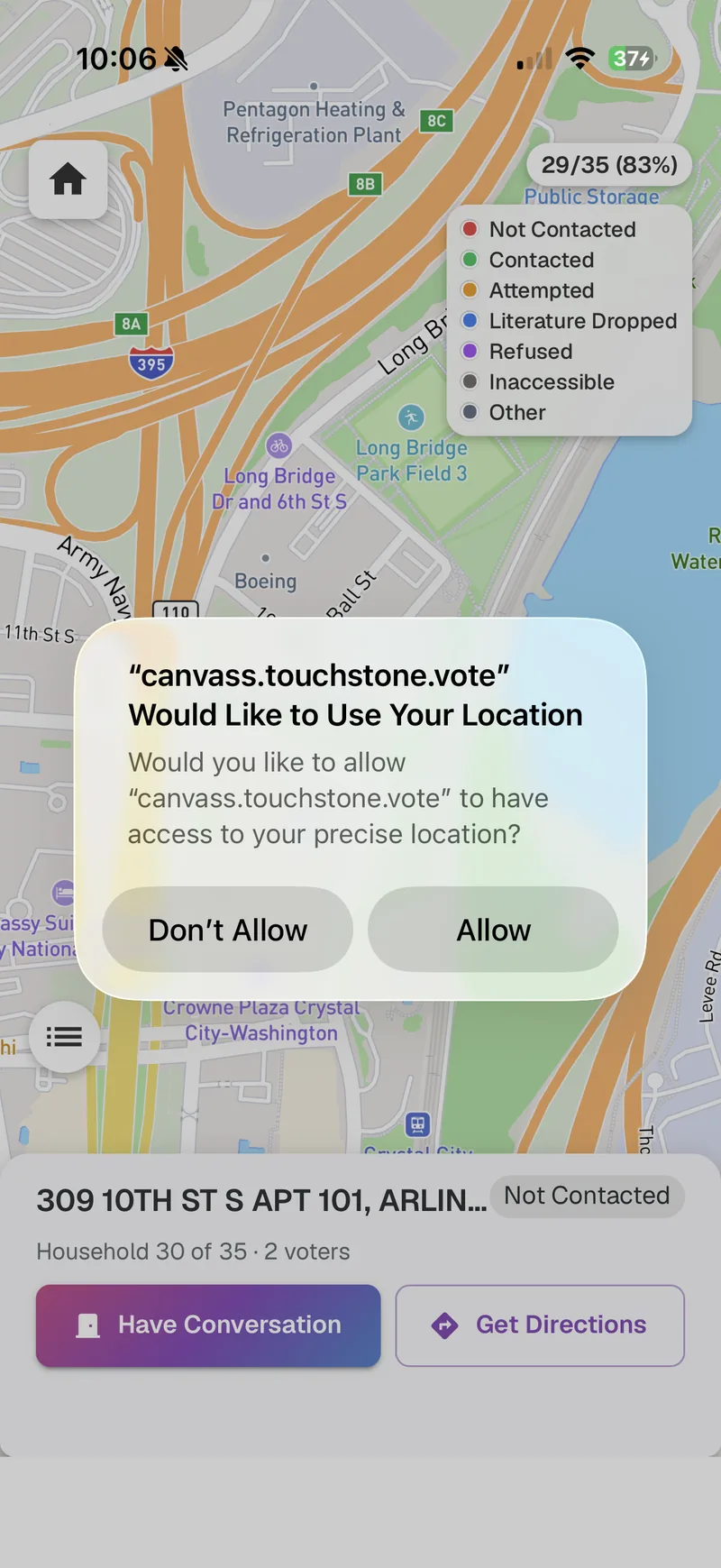
Canvassers verify their location at the door, and the record sticks.
Verification is a foundation of the platform.
What gets checked
From the doorstep to the admin console.
GPS & Accuracy
Where the canvasser stood, how confident the phone was in that reading, and when it happened, on every contact.
- Coordinates and timestamp per knock
- Accuracy rating on each contact
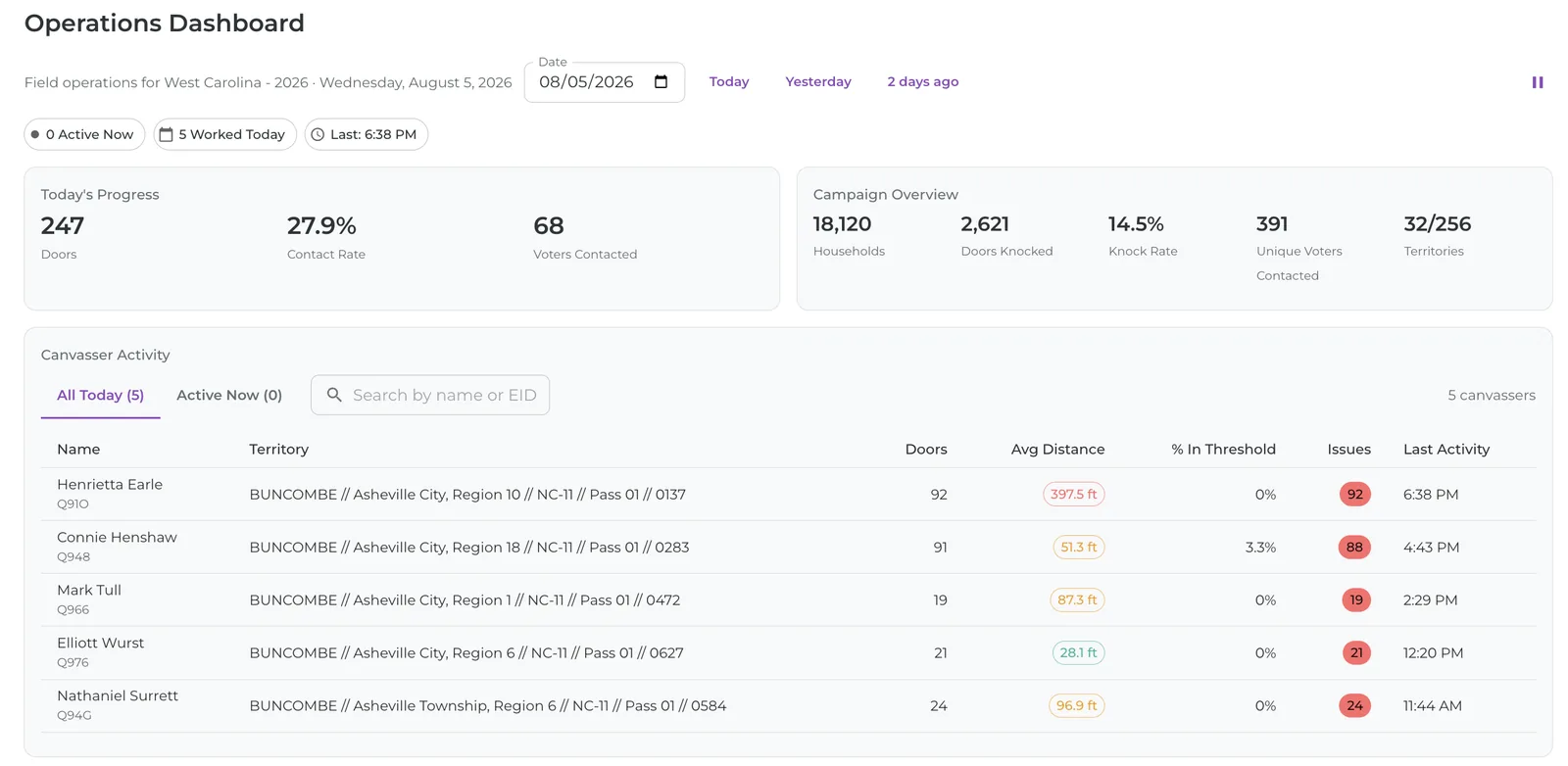
- Distance-to-door thresholds
- Full history per household
Anti-Spoofing
Location tricks get caught by proprietary detection techniques we continue to develop as spoofing tools evolve.
- Fake-GPS detection
- Activity patterns reviewed continuously
- Flagged contacts go to review, never silently deleted
- Geofenced turf boundaries
Accountability & Audit
The back office gets the same treatment as the doorstep.
- Audit logs on data changes
- Rollback for bad uploads
- Per-canvasser accountability
- Territory completion tracking
How spoofing detection actually works
Every contact arrives with three pieces of evidence: the device’s reported coordinates, the accuracy radius the phone itself attaches to that reading, and a timestamp. Detection starts by asking whether those three agree with each other and with the turf. A knock logged outside its geofenced boundary, a location reading whose accuracy radius can’t plausibly contain the household, or a distance-to-door beyond threshold each raises a flag on that contact.
Movement is the second class of signal. Real canvassing has a rhythm — walking pace between houses, time spent at a door, routes that follow streets. Spoofed locations tend to break that rhythm: contacts that jump between points faster than a person can walk, or activity patterns that don’t match how a shift actually unfolds. Those patterns are reviewed continuously, and the checks evolve as spoofing tools do.
A flagged contact is never silently deleted. It goes to review with its evidence attached, a person makes the call, and the decision lands in the audit log against that canvasser’s record.
That review step matters as much as the detection. Canvassers aren’t punished for a weak GPS signal on a porch with a metal roof — the accuracy rating travels with the contact, so honest noise is distinguishable from manipulation. What the program gets is a dataset where every record carries its own proof, and reporting you can hand to a donor without a caveat.
The same verification, across the whole program
Door knocks aren’t the only thing worth checking.
Survey Integrity
Structured, branching scripts keep answers consistent, so bad data stands out instead of blending in.
Suppression
Do-not-contact, moved, and deceased records are honored automatically, with a record of why each household was skipped.
Signature QC
Petition and signature work carries the same GPS accountability as canvassing, and validity rates show it.
Ask us the hard questions
Bring your worst field-data story and we’ll show you, on live software, how it would have gone on TouchStone.